AI Overviews Are Eating Your Traffic: What the 2026 Data Really Shows
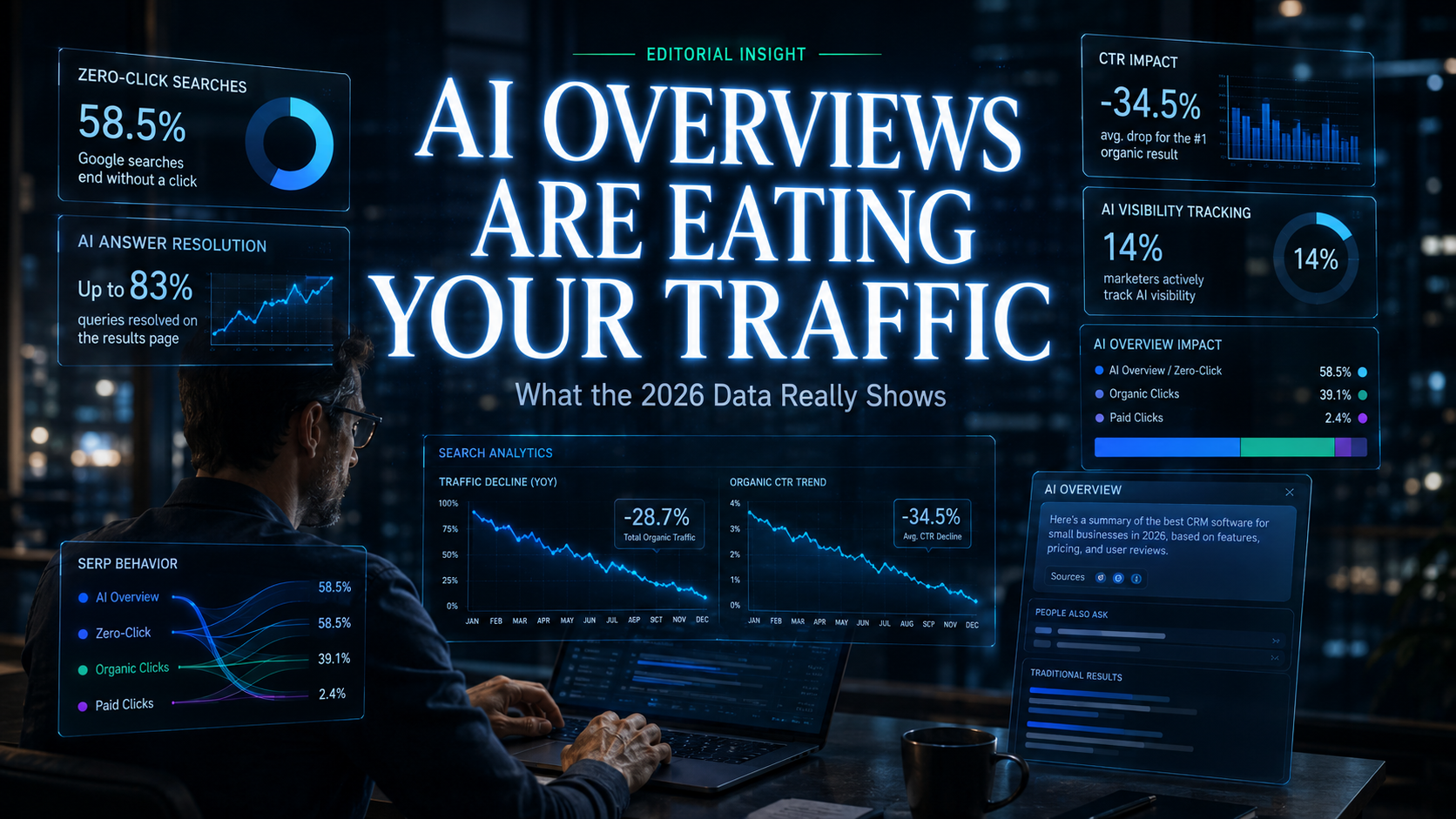
The AI Overviews traffic impact 2026 story is not only about lower rankings or a temporary Google test. It is about zero-click search, AI summaries, weaker organic CTR, measurement blind spots and the urgent need for AI visibility tracking beyond traditional SEO dashboards.
RV
Written byRankVipAI Editorial Team · SEO Insights for AI Tools, Content & Search
Published: June 3, 2026Updated: June 3, 2026Reading time: 10 minFocus keyword: AI Overviews traffic impact 2026
58.5%US Google searches ending with zero clicks in SparkToro/Datos 2024 data
34.5%Lower CTR for position-one pages in Ahrefs’ original AI Overview study
58%Lower CTR in Ahrefs’ 2026 update using December 2025 data
1%Visits where Pew observed users clicking a link inside an AI summary
Key Takeaways
AI Overviews traffic impact 2026 is best understood as a visibility problem, not just a traffic problem: users can see answers, brands and citations without visiting a website.
SparkToro and Datos found that 58.5% of US Google searches and 59.7% of EU Google searches ended without a click in 2024, giving marketers a hard baseline for the zero-click world.
Ahrefs found that AI Overviews correlated with a 34.5% lower CTR for top-ranking pages in its 2025 study, and later reported a 58% lower average CTR in its 2026 update.
Pew Research found that users who saw an AI summary clicked traditional results less often, and clicked a link inside the AI summary in just 1% of visits to pages with such summaries.
The practical response is not to abandon SEO. It is to add AI visibility tracking, stronger entity signals, better comparison pages, original data and citation-worthy content to the existing SEO system.
AI Overviews are turning SEO visibility into a zero-click battleground
AI Overviews are eating your traffic because they change the order of the search journey. In the classic SEO model, a user searched, scanned results, clicked a website and then evaluated the answer. In the AI Overview model, Google can summarize the answer first, cite sources later and leave the organic result fighting for attention below a generated response.
This does not mean every AI Overview kills every click. Google’s own launch messaging says AI Overviews help users get quick answers and links to learn more. But the independent data now points in a clear direction: when answers become more complete inside the results page, many users have less reason to click through.
That distinction matters for RankVipAI readers because AI tool categories are exactly the kind of informational and comparison-driven searches that AI systems can summarize: “best AI SEO tools,” “Semrush vs Ahrefs,” “best AI tools for marketers,” “what is GEO,” “which AI content tool should I buy,” or “how do I track AI Overview visibility?” These searches may still produce impressions. They may still influence buyers. But the traffic attached to them can become thinner, less predictable and harder to attribute.
Editorial read
The mistake is treating AI Overviews as another SERP feature. They are closer to a new distribution layer. The search result is no longer only a list of destinations; it is becoming an answer interface that can absorb the click before the user reaches your page.
The zero-click baseline was already brutal before AI Overviews scaled
The strongest baseline comes from the SparkToro/Datos zero-click study. Using US and EU clickstream panels, SparkToro reported that 58.5% of American Google searches and 59.7% of European Union Google searches resulted in zero clicks in 2024. In practical terms, many searches ended on Google or turned into another query without any external website visit.
That matters because AI Overviews did not create zero-click search from scratch. Featured snippets, knowledge panels, local packs, shopping modules, People Also Ask blocks, video results and Google-owned properties had already trained users to resolve many tasks inside the SERP. AI Overviews simply make that behavior more powerful because the answer can be longer, more synthesized and more conversational.
Bain & Company’s research adds another business-level angle: AI summaries and zero-click experiences are not only an SEO issue; they are a marketing model issue. Bain reported that about 80% of consumers rely on zero-click results in at least 40% of their searches, and estimated that this behavior has reduced organic web traffic by 15% to 25% in affected contexts.
Signal
What the data says
Why it matters for SEO
Zero-click baseline
58.5% of US Google searches and 59.7% of EU Google searches ended with zero clicks in SparkToro/Datos 2024 data.
Even before AI Overviews, a majority of searches did not produce an external visit.
AI summary behavior
Pew found that users who encountered an AI summary clicked traditional search results less often than users who did not.
AI summaries can reduce the practical value of ranking if the user’s answer is resolved above the organic listing.
CTR pressure
Ahrefs first reported a 34.5% lower average CTR for top-ranking pages when AI Overviews appeared, then later reported a 58% lower average CTR in its 2026 update.
Position one can still matter, but the same ranking may produce fewer clicks than it used to.
Measurement gap
Google Search Console does not provide a clean separate report for AI Overview impressions and clicks.
Teams need external tracking and proxy dashboards to see whether they are visible in AI answers.
Important caveat
Some industry summaries cite an “up to 83% zero-click rate” for AI Overview-triggered queries. That number is useful as a warning signal, but it should be treated as an industry estimate unless you are looking at the original dataset behind the claim. The more defensible takeaway is simpler: every major independent data point points toward fewer clicks when answers become more complete inside the search result.
What the CTR studies actually show
Ahrefs’ original analysis selected 300,000 keywords and compared AI Overview-triggering queries with informational queries that did not trigger AI Overviews. The finding was sharp: the presence of an AI Overview correlated with a 34.5% lower average click-through rate for the top-ranking page compared with similar informational keywords without an AI Overview.
Then the picture became even more serious. In its 2026 update, Ahrefs re-ran the study using December 2025 data and reported that AI Overviews correlated with a 58% lower average CTR for the top-ranking page. That does not mean every site will lose exactly 58% of clicks, because query type, brand strength, industry, intent and SERP layout all matter. But it does show that AI Overviews can turn a strong ranking into a weaker traffic asset.
Pew Research Center gives another behavioral clue. In a study of Google searches collected in April 2025, Pew found that users who encountered an AI summary clicked a traditional search result in 8% of visits, compared with 15% for users who did not encounter an AI summary. Pew also found that users clicked a link inside the AI summary in just 1% of visits to pages with such summaries.
01
Ranking still creates exposure
Being high in Google can still help a page become eligible for citations, topical trust and classic clicks. The problem is that exposure no longer guarantees traffic.
02
CTR is becoming query-dependent
Informational searches, definitions, how-to questions and software comparisons are especially exposed because AI summaries can answer them quickly.
03
Citations are not the same as visits
An AI Overview citation can build authority, but a citation is not automatically a session, lead, affiliate click or conversion.
04
Analytics undercounts influence
If a user sees your brand in an AI answer and searches your name later, the original AI exposure may never appear as the source in your analytics.
Why ranking number one is no longer enough
The old SEO promise was simple: rank higher, get more clicks. The 2026 reality is more complicated. A page can rank well, lose traffic, appear as an AI citation, drive branded demand, influence a later conversion and still look weaker in a traditional organic report.
This is the central measurement trap. If your dashboard only tracks rankings, clicks and sessions, it can make a useful page look like it is failing. If your dashboard only tracks traffic, it misses brand exposure inside AI Overviews, ChatGPT, Gemini, Perplexity, Copilot and other answer engines. If your dashboard only tracks AI mentions, it may ignore whether those mentions convert later through branded search or direct visits.
For content teams, the job is no longer “publish more articles around keywords.” The job is to build pages that are easy for both humans and machines to trust, quote, compare, summarize and validate. That means clear methodology, source transparency, structured data, strong internal linking, frequent updates and real editorial judgment.
RankVipAI interpretation
The winning page in 2026 is not only the page that ranks. It is the page that gets cited, remembered, compared and trusted when the buyer asks an AI system which tool, platform or category deserves attention.
What this means for AI tool sites, comparison pages and affiliate SEO
AI tool sites are especially exposed because their highest-value searches often live in the exact middle of the funnel. A buyer may search for “best AI SEO tools,” “Semrush vs Ahrefs,” “Frase vs Surfer SEO,” “best AI tools for marketers,” “AI content optimization tools,” or “how to track AI search visibility.” These are valuable queries, but they are also easy for AI Overviews to summarize.
That creates a paradox. The content still matters because AI systems need trusted sources, structured explanations and comparison data. But the monetization path changes. If the user gets the summary in Google, the site may lose the visit. If the page is not cited, the site may lose influence entirely. If the brand is cited but the CTA is never clicked, the site needs other ways to turn visibility into demand.
This is why RankVipAI should treat AI Overviews as both a threat and a positioning opportunity. Pages with strong editorial frameworks, transparent methodology and internal comparison clusters can become source material for AI systems. Thin review pages, copied feature lists and generic “best tools” content are much easier to replace with a generated summary.
Review pages need more than pros and cons. They need methodology, use cases, pricing context, limitations and update history.
Comparison pages should answer the exact decision question: who should choose tool A, who should choose tool B, and where each product breaks down.
Category hubs should connect rankings, reviews, comparisons and editorial insights so AI systems can understand the site’s topical authority.
Affiliate CTAs should be supported by trust signals, not dropped into thin content that AI summaries can bypass.
What to measure beyond rankings in 2026
The practical answer to AI Overviews traffic impact 2026 is measurement. Not panic. Not abandoning SEO. Not pretending rankings no longer matter. The right move is to add a visibility layer that captures what classic SEO tools were not built to see.
01
AI Overview presence
Track which priority queries trigger AI Overviews, how often they appear, and whether the AI block changes by device, country or query wording.
02
Source citation share
Measure whether your domain is cited, which page is cited, which competitors appear, and whether citation patterns change after updates.
03
AI answer accuracy
Log whether AI systems describe your brand, tool category, pricing, methodology and recommendations correctly or mix your position with competitors.
04
Branded demand lift
Watch branded searches, direct visits, newsletter signups and return visits after AI visibility improves, because AI exposure may convert later.
05
Comparison query coverage
Track “tool vs tool,” “best tool for use case,” “alternatives,” “pricing,” “review” and “for marketers” terms separately because they behave differently.
06
Assisted conversion paths
Separate direct affiliate clicks from assisted influence. Some users will discover a tool through AI search and convert through branded navigation later.
The strongest response is to make the site harder to summarize badly and easier to cite correctly. That means improving the underlying information architecture, not only adding more keywords. AI systems need clear entities, stable facts, updated comparisons, original evaluation criteria and pages that explain why a recommendation is credible.
For RankVipAI-style content, the highest-leverage move is to turn every important category into a connected cluster: one ranking hub, individual reviews, direct comparisons, methodology pages, editorial insights and update history. The more coherent the cluster, the easier it is for Google and AI systems to understand what the site is authoritative about.
Action
Why it helps
RankVipAI example
Add original methodology
AI systems need a reason to trust your ranking beyond generic feature lists.
Freshness matters in AI search because models and SERPs change quickly.
Show publication and update dates on AI SEO and AI tools pages.
Make pages quotable
Concise definitions, tables, verdicts and FAQs are easier for answer systems to extract.
Add verdict blocks, comparison tables and short FAQs to every high-value review.
Track AI visibility
Classic ranking tools alone cannot show whether your content is being used inside generated answers.
Use AI SEO tools and manual prompt checks for priority clusters.
The SEO stack has to include AI visibility tools now
Classic SEO tools still matter. You still need keyword research, rank tracking, technical audits, backlinks, content optimization and competitive analysis. But AI Overviews add a new job: measuring whether your brand and pages appear in generated answers. That is why AI SEO tracking is becoming its own category.
For teams building content around AI tools, the best approach is not to pick one measurement source and trust it blindly. Combine classic rank tracking, Google Search Console, SERP feature monitoring, AI citation checks, competitor comparison queries and manual review of high-value prompts. AI answers can vary by wording, location, login state, freshness and model version.
Do not measure AI Overviews only as lost sessions. Measure them as a new layer of search visibility. The site that wins in 2026 will track rankings, citations, brand mentions, answer accuracy and conversion paths together.
Final verdict: AI Overviews do not kill SEO, but they punish lazy SEO
The data does not support the comforting idea that everything is fine. Zero-click search is already mainstream. AI summaries make the results page more self-contained. Independent CTR studies show meaningful click pressure. Users often resolve queries without visiting a website. And marketers still lack clean native reporting for AI Overview exposure.
But the data also does not support the lazy idea that SEO is dead. The better conclusion is that SEO has expanded. Ranking is still important, but it is only one layer. The new search game also includes entity authority, source credibility, AI citation share, answer accuracy, branded demand, comparison visibility and measurement beyond clicks.
For AI tool sites, the opportunity is clear. Generic content will be summarized away. Strong editorial assets can become the source material that AI systems use to answer buyers. The difference will come from methodology, structure, updates, internal linking, original analysis and clear recommendations that deserve to be quoted.
RankVipAI verdict
AI Overviews traffic impact 2026 is one of the most important SEO topics for AI tool publishers because it changes what success means. The goal is no longer only “rank and get the click.” The goal is “rank, get cited, be trusted, be remembered and still convert when the click path changes.”
Build an SEO strategy that survives AI Overviews
Use RankVipAI to compare AI SEO tools, AI visibility tracking platforms, marketing tools and search workflows built for the zero-click era.
Independent studies suggest that AI Overviews can reduce clicks to organic results, especially for informational queries. Ahrefs found a 34.5% lower average CTR for top-ranking pages in 2025 and later reported a 58% lower average CTR in a 2026 update using December 2025 data.
What is the AI Overviews traffic impact in 2026?
The AI Overviews traffic impact in 2026 is not just a ranking problem. It combines zero-click behavior, direct answers in Google, lower CTR for top organic results, and weaker visibility measurement in traditional analytics tools.
Can Google Search Console separate AI Overview clicks?
As of this article date, Google Search Console does not give publishers a clean, separate AI Overview click and impression report. Teams usually need external SERP tracking, manual query monitoring, AI visibility tools and landing page analysis to estimate exposure.
Is SEO dead because of AI Overviews?
No. SEO is not dead, but the job has changed. Ranking is still valuable, yet teams also need to measure AI citations, entity authority, comparison visibility, branded demand and whether content is cited inside answer engines.
What should AI tool sites measure beyond rankings?
AI tool sites should measure AI Overview presence, source citations, brand mentions in AI answers, comparison query visibility, AI search referral traffic, branded search lift, assisted conversions and share of voice across traditional and generative search experiences.
How can content teams respond to AI Overviews?
Content teams should create citation-worthy pages, add original data, improve entity clarity, use structured comparison formats, maintain strong internal linking, update pages frequently and track AI search visibility separately from classic blue-link rankings.
Editorial note: This article is part of RankVipAI’s SEO Insights coverage. It summarizes public research from SparkToro/Datos, Ahrefs, Pew Research Center, Bain & Company, Google and 2026 AI search reporting, then interprets the practical meaning for AI tool publishers, SEO teams, affiliate sites and marketers tracking visibility beyond traditional rankings.
Independent AI rankings, reviews, and comparisons powered by the VIP AI Index™ — built for readers who want clearer research, faster decisions, and no paid placements.