Search Atlas Review 2026: OTTO SEO and AI Search Automation
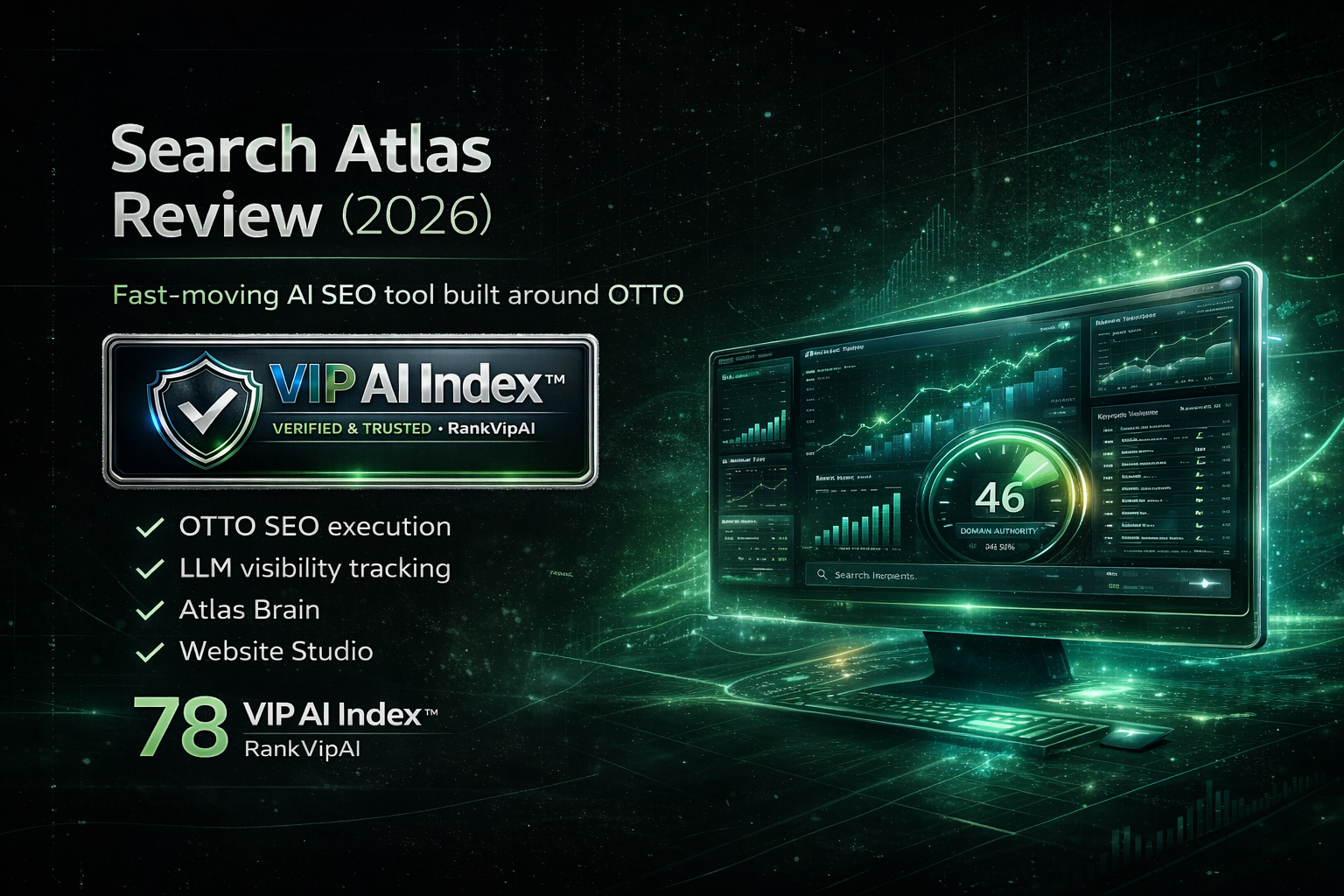
Search Atlas is a fast-moving AI SEO automation platform built around OTTO SEO — a layer designed to do more than diagnose issues. It aims to help teams research, optimize, publish, and deploy changes across traditional SEO and AI search workflows from one stack.
Search Atlas Review Verdict — March 2026
That implementation-first approach makes Search Atlas feel different from the established category leaders. Atlas Brain, Website Studio, LLM visibility tracking, Smart Ads, CMS publishing, and OTTO workflows give it a strong “do the work, not just inspect the work” angle. For agencies and operators who want fewer handoffs, that is a meaningful advantage.
The catch: Search Atlas is still a newer, faster-evolving platform than Semrush or Ahrefs. It feels ambitious and modern, but also less battle-tested. If your priority is the deepest backlink database, the most mature research stack, or the broadest third-party trust, the old guard still feels safer. Search Atlas wins on automation and workflow, not on category-wide certainty.
What Search Atlas actually does well
Search Atlas is broad, but the real story is its attempt to collapse strategy, implementation, and publishing into one workflow.
Core platform modules in Search Atlas
Search Atlas pricing plans
Search Atlas shows four public paid tiers plus a 7-day free trial. The jump from Starter to Growth matters because that is where LLM visibility tracking and broader automation start to open up.
| Plan | Price | OTTO projects | Target keywords | User seats | LLM visibility | Standout tools | Best for |
|---|---|---|---|---|---|---|---|
| StarterEntry plan | $99/mo 7-day free trial |
1 project | 120 | 1 | ✗ | Atlas Brain · Website Studio · Bing instant indexing · Cloud Stacks | Solo operators testing the OTTO model |
| Growth | $199/mo Agency scaling tier |
2 projects | 300 | 3 | ✓ included | Smart Ads · CMS publishing · 1-click publishing | Growth-focused agencies and mid-sized teams |
| ProBest value | $399/mo Advanced SEO teams |
4 projects | 600 | 5 | ✓ included | All LLM models · enhanced authority building · white label | Teams centralizing more client work inside one stack |
| Agency | $999/mo Large portfolios |
10 projects | 1,500 | 10 | ✓ included | Client dashboards · priority support · max quotas | Large managed SEO service operations |
Search Atlas vs Semrush vs Ahrefs vs Scalenut
Search Atlas is easiest to understand when compared against the category leaders and its nearest workflow-style rival.
| Feature | Search Atlas | Semrush | Ahrefs | Scalenut |
|---|---|---|---|---|
| AI automation | ★ OTTO deploys fixes and optimizations | More guidance than deployment | Mostly research-focused | Workflow automation, lighter implementation |
| Backlink depth | Good, but not category-leading | Strong | ★ Deepest, most trusted link research | Not a core strength |
| LLM / AI visibility | Integrated from Growth upward | Strong AI visibility direction | Emerging via Brand Radar | Useful AI visibility workflow |
| Content workflow | Broad, tied to publishing | Broad, but less execution-centric | More research-heavy | ★ Simpler, cleaner content ops |
| Technical implementation | ★ Direct deployment angle | Recommendations + audits | Recommendations + audits | More optimization than technical deployment |
| Publishing workflow | ★ Universal CMS + 1-click publishing | Broader suite, but publishing is less central | Not a core differentiator | Useful auto-publish support |
| White label / agency ops | Meaningful upper-tier support | Agency-friendly | Less agency-ops focused | Less mature for large service delivery |
| Ease of use | Moderate learning curve | Dense but familiar | Cleaner than Semrush for many users | ★ Most approachable for content teams |
| Best fit | Agencies that want action, not only reporting | All-in-one enterprise SEO operations | Backlink and competitor research specialists | Lean teams prioritizing content workflow |
| Overall maturity | Promising, but newer | ★ Very mature | ★ Very mature | Solid, but narrower |
Where Search Atlas wins — and where it still lags
Search Atlas is not trying to be modest. That ambition is a real advantage, but it also creates tradeoffs.
✓ Strengths
Search Atlas stands out when you want SEO software to move beyond reporting and actually help execute work inside the same environment.
OTTO gives Search Atlas a much more action-oriented feel than most SEO tools. It is built to help deploy fixes and optimizations rather than just list them.
LLM visibility and GEO thinking are embedded in the product direction. Search Atlas is clearly trying to adapt to AI search, not only traditional rankings.
The platform brings together research, audits, content, publishing, local SEO, and even paid search automation. That breadth is useful for agencies who want fewer disconnected tools.
White-label support, multiple seats, larger OTTO project limits, and scalable reporting make the product more compelling for managed-service teams than for casual solo users.
CMS publishing and 1-click deployment reduce friction between strategy, approval, and live execution. That matters for teams shipping content constantly.
Search Atlas does not feel like a simple Semrush imitation. OTTO, Website Studio, Atlas Brain, and the all-in-one execution angle give it a more distinct identity.
✗ Weaknesses
The main drawback is maturity. Search Atlas looks ambitious and modern, but category leaders still feel safer when trust, depth, and historical reliability matter most.
The innovation is real, but the product still has to earn the same category-wide trust and long-term confidence as the incumbents.
Because the platform tries to do so much, it can feel heavier and more complex than simpler content-first tools. Beginners may find lighter products easier to learn.
Serious link researchers may still prefer Ahrefs for confidence and maturity. Search Atlas is stronger on workflow and automation than on link-data leadership.
The entry tier shows the OTTO concept, but LLM visibility and broader workflow depth begin to unlock more meaningfully from Growth onward.
Growth and Pro are where Search Atlas starts to feel substantially more powerful, but those tiers push the platform into a more serious budget category.
Because the tool reaches across SEO, AI search, local, publishing, and PPC, specialist competitors may still feel tighter in specific narrow workflows.
Common questions about Search Atlas
These are the practical questions most buyers will ask before testing a platform like this.
The clearest difference is OTTO SEO. Search Atlas is not only trying to surface problems and opportunities — it is trying to implement fixes, content updates, indexing improvements, and other SEO actions directly from the platform.
Yes. Search Atlas publicly offers a 7-day free trial on its paid plans, which is enough time to test OTTO, reporting, publishing, and the broader workflow.
Not across the board. Search Atlas is more automation-oriented and implementation-focused, but Semrush and Ahrefs still feel deeper and more proven for large-scale research, backlink intelligence, and mature enterprise workflows.
It fits agencies, growth-focused marketers, and operators who want one platform to research, optimize, publish, and deploy changes without stitching together several separate tools.
Yes. Search Atlas now includes LLM visibility tracking and OTTO is positioned around SEO, AI search, and GEO workflows rather than only traditional SERP analysis.
For some teams, yes. Search Atlas is broader and more implementation-heavy. Scalenut can still feel simpler and more straightforward if your main focus is content workflow rather than a large all-in-one stack.
Not especially. The platform offers a lot, but that also means more complexity. Beginners may find lighter tools easier to learn, while advanced users will appreciate the breadth.
Because the product is ambitious and increasingly relevant for AI-era SEO, but it is still newer and less battle-tested than the category leaders. The innovation is real; the maturity gap is why it lands lower than the top tier.
Want an SEO platform that actually implements changes?
Search Atlas makes the strongest case when you want SEO software to do more than audit. If OTTO’s implementation-first model matches your workflow, it is one of the more interesting AI-era platforms to test right now.
Visit Search Atlas →