Augment Code Review 2026
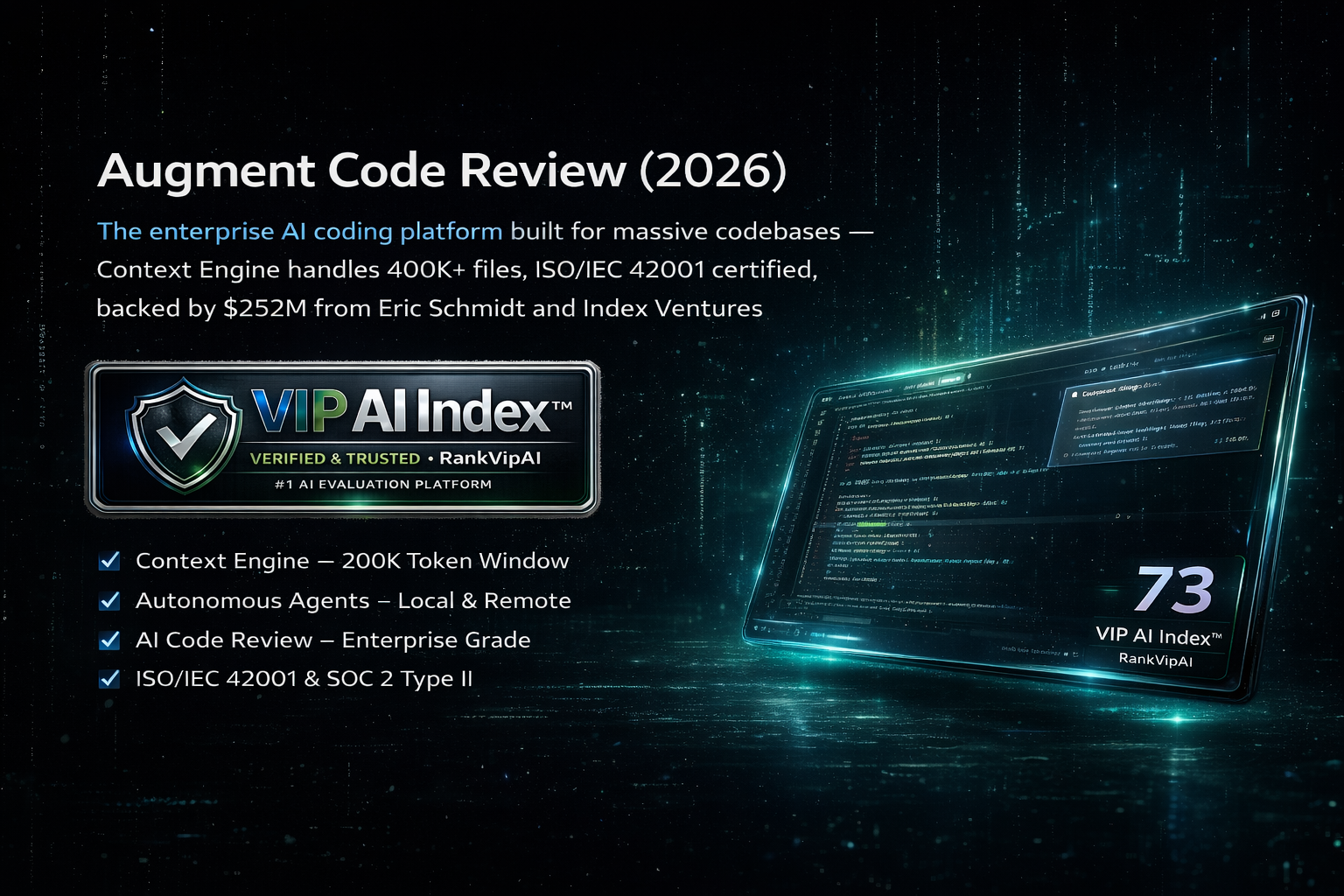
The enterprise AI coding platform built for massive codebases — Context Engine handles 400K+ files, ISO/IEC 42001 certified, backed by $252M from Eric Schmidt and Index Ventures.
Augment Code Review Verdict — March 2026
What Augment Code actually does
Augment is built for enterprise-scale codebases. The Context Engine is the core differentiator — it understands architectural relationships, not just autocomplete patterns.
Intelligent multi-model routing
Augment Code Pricing — March 2026
Credit-based pricing since October 2025. The Indie plan at $20/mo is the entry point for individual developers. Enterprise contracts are custom-priced.
| Plan | Price | Credits/mo | Agent Access | Context Engine | Code Review | Integrations | Support |
|---|---|---|---|---|---|---|---|
| Free Trial | $0 14 days |
600 messages | ✓ limited | ✓ | ✓ | ✗ | Community |
| Indie | $20/mo Solo developers |
40,000 credits | ✓ full | ✓ | ✓ | ✗ | Community + Portal |
| StandardFor teams | $60/mo Up to 20 users |
130,000 credits | ✓ full | ✓ | ✓ | ✓ | Community + Portal |
| Max | $200/mo High usage teams |
450,000 credits | ✓ full | ✓ | ✓ advanced | ✓ | Email + Portal |
| Enterprise | Custom SSO · SCIM · SLA |
Custom | ✓ | ✓ | ✓ enterprise | ✓ + custom | Dedicated + SLA |
Augment Code vs Cline vs Replit Agent
Comparing the #10, #11, and #12 AI coding tools — where Augment's enterprise focus differs from open-source and prototyping alternatives.
| Feature | Cline | Replit Agent | Augment Code |
|---|---|---|---|
| VIP AI Index™ Score | 76 — Solid Choice | 74 — Solid Choice | 73 — Solid Choice |
| Category Rank | #10 | #11 | #12 |
| Primary strength | ★ Open-source transparency | Rapid prototyping | Enterprise codebases |
| Context window | Model-dependent | Limited | ★ 200K tokens · 400K+ files |
| Enterprise security | BYO API keys | Basic | ★ ISO 42001 · SOC 2 Type II |
| IDE support | VS Code only | Replit editor | ★ VS Code + JetBrains + CLI |
| Pricing model | ★ Free + API costs | $25/mo Core | $20/mo Indie (credit-based) |
| Best for | Privacy-conscious devs who want full control | Quick prototypes and learning | Enterprise teams with large legacy codebases |
What works and what doesn't
Based on hands-on testing and enterprise deployment feedback in Q1 2026.
✓ Strengths
Augment’s upside is clearest in enterprise environments: unusually deep architectural context, serious compliance credentials, and broad IDE support for teams working across massive legacy systems.
400K+ file repositories with cross-service dependency tracking. For enterprise teams managing monorepos that no single developer can fully understand, this architectural awareness is transformative.
It addresses AI-specific governance concerns such as training data handling and model behavior monitoring that general SOC 2 compliance does not cover. This removes procurement barriers for regulated industries.
The agent remembers your coding style, architectural decisions, and project context. For multi-week refactoring projects, this continuity is a genuine productivity advantage over tools that start fresh each time.
Unlike Cursor (VS Code only), Augment works in IntelliJ, PyCharm, WebStorm, and via CLI. Enterprise teams with diverse IDE preferences can standardize on one AI tool.
When competing for business customers on production codebases, Augment's architectural understanding wins more often than it loses.
$252M from Eric Schmidt's Innovation Endeavors, Index Ventures, and Sutter Hill at a $977M valuation provides runway and credibility for enterprise procurement.
✗ Weaknesses
The trade-off is clear too: Augment is powerful for large organizations, but the pricing model is harder to predict, the workflow can feel slower on simple tasks, and human oversight still matters.
The October 2025 switch from message-based to credit-based pricing sparked user backlash. Without published consumption benchmarks, teams cannot reliably estimate whether Standard or Max tier will cover monthly usage. Auto top-up at $15 per 24K credits can add 40%+ to costs.
From unlimited plans to message-based to credit-based pricing, Augment has struggled to find a sustainable model. This pricing volatility is a concern for enterprise budget planning.
The Context Engine's architectural analysis adds latency. For quick autocomplete on trivial code, Cursor and Copilot feel snappier. Augment optimizes for accuracy over velocity.
Larger teams must negotiate custom Enterprise pricing. There's no published intermediate option, creating a gap that complicates procurement.
If you're building a side project or working solo on a small codebase, the Context Engine's power is wasted and the credit system is more expensive than Cursor's flat $20/mo.
Despite the enterprise positioning, Augment's agents can and do make errors on complex architectural decisions. It reduces onboarding time but doesn't replace experienced engineering judgment.
Frequently asked questions
Augment Code offers a 14-day free trial with 600 messages (approximately 30,000 credits in the new model). Adding a credit card unlocks 30,000 bonus credits valid for 3 months. The free trial includes full access to the Context Engine and agent capabilities but excludes team integrations. A free Community tier existed previously but was removed — the current entry point is the $20/mo Indie plan after the trial ends.
Cursor scores 92/100 (#1) vs Augment's 73/100 (#12) on the VIP AI Index™. The key difference: Cursor optimizes for coding velocity with best-in-class Tab autocomplete and agent mode in a single IDE. Augment optimizes for architectural understanding of massive enterprise codebases. Choose Cursor for general development, side projects, small-to-medium codebases, and predictable $20/mo pricing. Choose Augment for enterprise monorepos with 100K+ files, regulated industries requiring ISO 42001 certification, and teams needing persistent context across multi-week projects.
The Context Engine is Augment's core differentiator — it maintains a live understanding of your entire codebase including code, dependencies, architecture patterns, and commit history. While most AI coding tools understand individual files and their immediate imports well, they struggle with architectural-level comprehension. The Context Engine handles 400K+ file repositories and tracks how changes in one service affect others. For enterprise teams where debugging a service that talks to twelve other services is common, this architectural awareness prevents AI suggestions that would break authentication for half your users.
Since October 2025, Augment uses credits instead of message counts. A small task using 10 tool calls costs around 300 credits. A complex task requiring 60 tool calls costs around 4,300 credits. A moderately sized PR review under 1,000 lines consumes approximately 2,400 credits. The Indie tier (40,000 credits) enables roughly 16-17 PR reviews per month. Standard tier (130,000 credits) handles about 54 reviews. When you exhaust monthly credits, auto top-up activates at $15 per 24,000 credits. Credits are pooled at the team level — a 20-developer team on Standard gets 2,600,000 credits total.
Augment Code supports VS Code, JetBrains IDEs (IntelliJ, PyCharm, WebStorm, DataGrip, etc.), Vim/Neovim, and CLI. This is a significant advantage over Cursor (VS Code only). For enterprise teams with developers using different IDEs, Augment provides a consistent AI experience across environments. The VS Code extension is available on the Visual Studio Marketplace, JetBrains plugins on the JetBrains Marketplace, and the Vim integration via GitHub.
Augment is designed for enterprise security requirements. ISO/IEC 42001 certification specifically covers AI governance, training data handling, and model behavior monitoring — going beyond general SOC 2 compliance. SOC 2 Type II certification confirms security controls are operating effectively over time. A Proof-of-Possession architecture ensures code completions apply only to files locally in the developer's possession. Paid plans exclude AI training on your data per the Commercial Terms of Service. Enterprise plans add SSO, SCIM, customer-managed encryption keys, and SIEM integration.
Enterprise context for massive codebases
Context Engine handles 400K+ files. ISO 42001 certified. Free trial available — no credit card required to start.
Try Augment Code Free →