Tabnine Review 2026
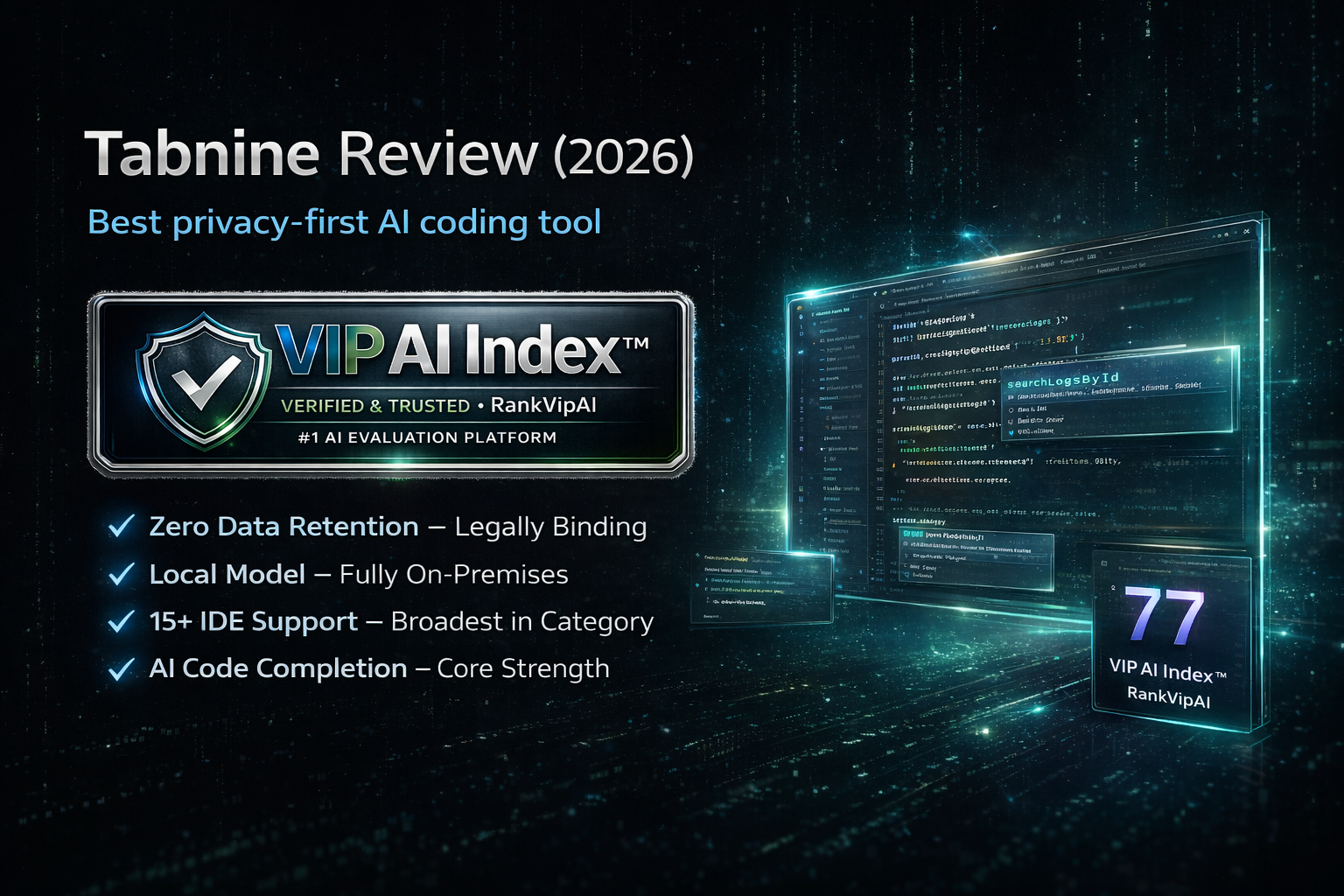
This Tabnine review explains why Tabnine ranks #9 among AI Coding Assistants in 2026. We cover zero data retention, local model deployment, 15+ IDE support, pricing, and whether Tabnine is the best fit for privacy-constrained teams and regulated environments.
Tabnine Review Verdict — March 2026
What Tabnine actually does
A mature, privacy-first coding assistant with the broadest IDE support in the category and uniquely strong guarantees around code data.
How Tabnine compares on code privacy
Privacy claims vary significantly across tools. This table maps what each tool actually commits to contractually versus by policy.
| Tool | No training on code | Contractual guarantee | Local model option | Zero data retention | Air-gapped capable |
|---|---|---|---|---|---|
| Tabnine Pro/Enterprise | ✓ Yes | ✓ Contractual DPA | ✓ Enterprise | ✓ Pro+ | ✓ Local model |
| Cursor Pro | ✓ Yes | ⚠ Policy only | ✗ | ⚠ Privacy mode only | ✗ |
| GitHub Copilot Business | ✓ Yes | ✓ Enterprise DPA | ✗ | ⚠ Varies by plan | ✗ |
| Amazon Q Developer Enterprise | ✓ Yes | ✓ AWS DPA | ✗ | ✓ Pro+ | ⚠ VPC only |
| Sourcegraph Cody Enterprise | ✓ Yes | ✓ Enterprise DPA | ⚠ Via Ollama | ✓ Self-hosted | ✓ Self-hosted + local model |
Three deployment modes to fit any security requirement
Tabnine Pricing — March 2026
Competitive pricing with privacy guarantees as the main differentiator. Pro at $12/user/mo undercuts Cursor and gives teams a privacy-committed alternative.
| Plan | Price | Completions | Chat | Zero data retention | Local model | IDE support | Team learning |
|---|---|---|---|---|---|---|---|
| Basic | $0 Free forever |
Limited | ✗ | ✗ | ✗ | VS Code · JetBrains | ✗ |
| ProRecommended | $12/mo Per user |
Unlimited | ✓ | ✓ Contractual | ✗ | 15+ IDEs | ✗ |
| Enterprise | $39/mo Per user · min seats |
Unlimited | ✓ Full | ✓ DPA included | ✓ Full air-gap | 15+ IDEs | ✓ Codebase personalization |
Tabnine vs Cursor vs GitHub Copilot
Tabnine’s comparison is most meaningful against tools evaluated on the same privacy-first criteria — where contractual guarantees and local deployment become decisive.
| Feature | Tabnine | Cursor | GitHub Copilot |
|---|---|---|---|
| VIP AI Index™ Score | 77 — Solid Choice | 92 — VIP Elite · #1 | 89 — VIP Elite · #3 |
| Contractual zero data retention | ★ Pro+ — legally binding DPA | Privacy mode — policy only | Business/Enterprise DPA |
| Local model (air-gapped) | ★ Enterprise — full offline | ✗ Not available | ✗ Not available |
| IDE support breadth | ★ 15+ IDEs including Eclipse, Emacs, Vim | VS Code fork only | VS Code · JetBrains · Neovim · Vim |
| Tab autocomplete quality | Good — strong on JVM languages | ★ Best in category | Excellent · multi-model |
| Chat / agent capability | Basic chat — no agent mode | ★ Best — Tab + Agent + multi-model | Excellent Chat · Workspace agent (beta) |
| Innovation / feature velocity | 68/100 — slowest in top 10 | ★ Fastest in category | Good — consistent shipping |
| Track record / longevity | ★ Since 2018 — longest in category | Since 2022 | Since 2021 |
| Best for | Privacy-constrained orgs, air-gapped dev, broad IDE coverage | Best daily coding experience, any team | Best value + GitHub workflows |
What works and what doesn’t
Based on hands-on testing across VS Code, JetBrains, and Eclipse workflows, with special focus on privacy and compliance scenarios in Q1 2026.
✓ Strengths
Tabnine’s upside is very clear: compliance-grade privacy guarantees, the broadest IDE support in the category, and a credible local deployment story for security-sensitive teams.
For organizations that need legally enforceable guarantees about code data handling rather than policy statements, Tabnine’s DPA-backed zero retention commitment provides a level of certainty that simplifies security reviews and vendor assessments. Other tools may make similar claims in documentation; Tabnine makes them in contracts.
For classified environments, offline industrial systems, or organizations where code cannot touch external APIs under any circumstance, Tabnine’s local model is genuinely valuable. This is a niche requirement, but for the teams that have it, the feature is non-negotiable.
Eclipse users, Emacs users, JetBrains teams, VS Code developers, and Visual Studio teams can all operate under one product umbrella. For large organizations where “standardize on one IDE” is unrealistic, that breadth is a major procurement advantage.
Java, Kotlin, and Scala developers consistently report strong completion quality, and Tabnine’s historical focus on enterprise development shows in how well it handles common JVM workflows relative to many newer competitors.
Tabnine is battle-tested at enterprise scale. The integrations are stable, regressions are rarer than in faster-moving tools, and the product has enough operational history to make risk-averse IT and procurement teams more comfortable adopting it.
✗ Weaknesses
The tradeoff is equally clear: Tabnine offers strong compliance and coverage, but it trails the leaders on modern AI capability, feature velocity, and agentic workflows.
Tabnine’s 68/100 innovation score reflects the slowest feature velocity among the leading tools. While competitors shipped agents, multi-model workflows, and more advanced next-edit prediction, Tabnine evolved more conservatively and the capability gap widened.
There is no equivalent to Cursor Agent, Claude Code, or Copilot Workspace here. For teams that increasingly rely on autonomous multi-file execution rather than just completion and chat, Tabnine simply does not compete at the top end of the market.
Despite its long history, Tabnine no longer leads in the core completion feature it pioneered. Cursor’s fine-tuned Tab model and other newer systems outperform it on more advanced multi-line and context-heavy prediction tasks.
The local model is useful precisely because it is isolated, not because it is the strongest model available. Organizations adopting it should expect a meaningful quality drop versus Tabnine Cloud and an even larger gap versus best-in-class cloud tools.
At $39/user/mo, Tabnine Enterprise is priced like GitHub Copilot Enterprise while delivering materially weaker AI capability. The premium only makes sense when local deployment, zero retention guarantees, or broad IDE coverage are mandatory requirements.
Frequently asked questions
Tabnine Pro and Enterprise offer some of the strongest contractual protections in the coding assistant category. The zero data retention guarantee is backed by a DPA, which gives it legal force beyond a standard privacy policy. For maximum isolation, Tabnine Enterprise’s local model goes further and runs entirely offline with no network transmission at all. Whether that makes it “the safest” depends on your threat model, but for organizations worried about external code retention, logging, or training, Tabnine is one of the strongest options available.
The local model is noticeably less capable than Tabnine’s cloud mode, which itself sits below the strongest cloud tools like Cursor or Copilot. In practice, the local model is useful for simple to moderate completions and pattern continuation, but it struggles more with complex multi-line reasoning and broader code context. Teams choosing the local model are making a conscious tradeoff: maximum data isolation in exchange for lower AI capability.
Yes. That is one of Tabnine’s biggest strengths. It supports Eclipse, all major JetBrains IDEs, VS Code, Visual Studio, Neovim, Vim, Emacs, Sublime Text, and more. For enterprises with legacy Java workflows, mixed toolchains, or developer populations that have not standardized around modern editors, Tabnine remains unusually practical compared with more narrowly focused competitors.
Choose Tabnine if your organization needs local model deployment, very broad IDE support, or a strict zero-retention position with minimal code movement outside your network. Choose GitHub Copilot Enterprise if your developers are mostly in VS Code and JetBrains, you want deeper GitHub workflow integration, and you care more about overall AI capability than about local deployment. Both can fit regulated environments, but Tabnine becomes especially compelling when external API calls are heavily restricted or prohibited outright.
Yes, but in a narrower role. Tabnine is no longer the general-purpose AI coding leader for pure capability; Cursor, Copilot, and Claude Code are stronger for that. Tabnine remains relevant because it owns a defensible niche around compliance, local deployment, and extremely broad IDE coverage. Teams without those constraints will usually get more raw AI value from other tools, but teams with strict privacy or environment requirements may still find Tabnine the best fit.
Privacy-first AI coding — code stays yours, guaranteed
Zero data retention contractual guarantee. Local model for air-gapped environments. 15+ IDEs. Free to start.
Try Tabnine Free →