Windsurf Review
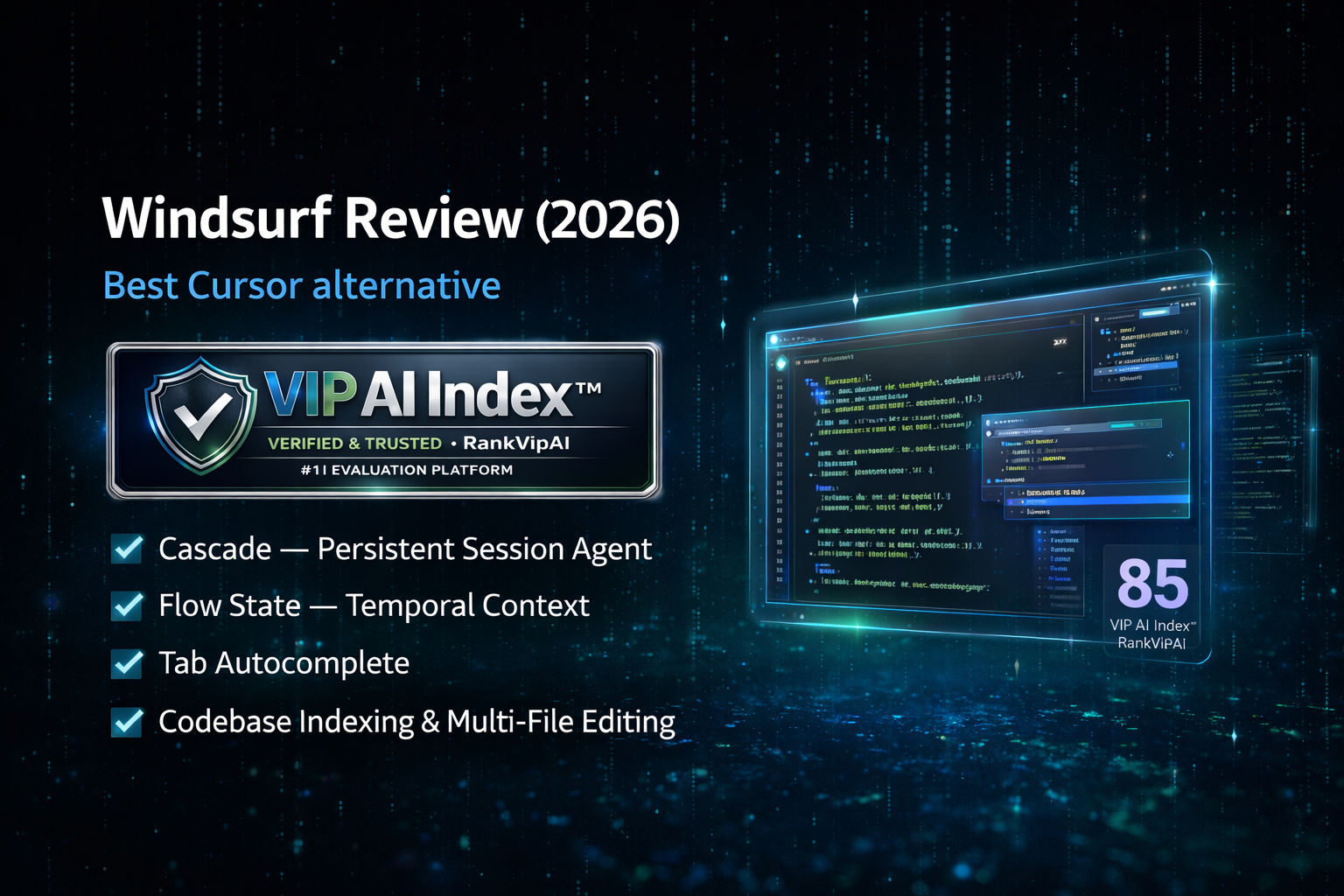
The strongest Cursor alternative — a VS Code fork with Cascade agent, persistent session awareness, and Flow state continuous context at $15/mo Pro.
Windsurf Review Verdict — March 2026
What Windsurf actually does
A VS Code fork with AI deeply integrated — familiar environment, different agent philosophy than Cursor.
Available AI models in Windsurf
Cascade vs Cursor Agent — two philosophies
Neither is strictly better — they suit different working styles. Understanding this difference is the key to choosing between Windsurf and Cursor.
Windsurf pricing — March 2026
$15/mo Pro sits between Copilot ($10) and Cursor ($20). The free Hobby plan includes unlimited autocomplete — the most generous free tier in the VS Code fork category.
| Plan | Price | Cascade agent | AI models | Autocomplete | Flow state | Team features |
|---|---|---|---|---|---|---|
| Hobby | $0 Free forever |
Limited · slow models | Codeium models | ✓ unlimited* | Basic | ✗ |
| ProRecommended | $15/mo Billed monthly |
500 fast + unlimited slow | Claude 3.7 · GPT-4o · Codeium | ✓ unlimited | ✓ Full | ✗ |
| Teams | $35/mo Per seat |
Unlimited | All models | ✓ unlimited | ✓ Full | ✓ Admin · shared context |
| Enterprise | Custom SSO · SLA |
Unlimited | All + custom | ✓ | ✓ | ✓ SSO · compliance |
Windsurf vs Cursor vs GitHub Copilot
The three most popular VS Code AI coding tools compared — where Windsurf wins, where it trails, and who should choose it.
| Feature | Windsurf | Cursor | GitHub Copilot |
|---|---|---|---|
| VIP AI Index™ Score | 85 — VIP Pick | 92 — VIP Elite · #1 | 89 — VIP Elite |
| Price | $15/mo Pro | $20/mo Pro | ★ $10/mo Pro |
| Agent philosophy | ★ Cascade — continuous session awareness | On-demand — explicit task execution | Workspace — task-based (beta) |
| Tab autocomplete | Good — comparable to Copilot | ★ Best — multi-line prediction | Excellent · GPT-4o / Claude 3.5 |
| Free plan autocomplete | ★ Unlimited (rate-limited) | Limited | 2,000/mo |
| JetBrains support | ✗ No | ✗ No | ★ Native plugin |
| Long-term roadmap | ⚠️ Uncertain — OpenAI acquisition | ★ Independent · clear roadmap | Microsoft/GitHub · stable |
| Anthropic model access | Claude 3.7 ✓ now · ⚠️ long-term uncertain | ★ Claude 3.7 · multi-provider · stable | Claude 3.5 Sonnet · stable |
| Best for | Continuous-context agent fans, $5/mo saving vs Cursor | Best overall experience, Tab autocomplete, teams | JetBrains, GitHub workflows, best value |
What works and what doesn't
Based on hands-on testing across VS Code workflows and Cascade agent sessions in Q1 2026.
✓ Strengths
Windsurf's strongest appeal is that it gives developers a genuinely different agent workflow than Cursor while remaining cheaper and easy to adopt from a standard VS Code setup.
For exploratory development sessions where goals evolve, Cascade's persistent context model is more coherent than Cursor's on-demand agent. Many developers report it feels more like pair programming.
$5/mo less is $60/year. For developers on the fence between the two tools, Windsurf's comparable core capability at lower price is a legitimate deciding factor.
Unlimited autocomplete on the Hobby plan, with rate limits for heavy use, lets you evaluate Windsurf's completion quality with no commitment. Cursor's free plan is more restrictive.
Raw model capability is identical. The difference is UX and agentic architecture, not AI quality. For the tasks Cascade handles well, quality matches Cursor Agent.
Windsurf's design is well-executed and the AI integration feels seamless. Some developers genuinely prefer the visual experience and UX flow over Cursor's.
✗ Weaknesses
The main downside is not capability but uncertainty: Windsurf is good enough to compete, but long-term predictability and agent maturity still tilt toward better-established alternatives.
This is the dominant factor in the 84/100 Reliability score. An OpenAI subsidiary running Anthropic as primary model is a strategic tension likely to resolve over 2026–2027. Teams building deep standardized workflows should plan contingencies.
Cursor's fine-tuned multi-line prediction model is the clearest daily-use gap. Developers for whom autocomplete frequency and accuracy is the primary evaluation criterion will find Cursor ahead.
Continuous awareness is an advantage for session coherence, but for executing complex, well-defined multi-file tasks, Cursor Agent handles the implementation steps more reliably in head-to-head testing.
Windsurf only exists as a VS Code fork. The entire JetBrains developer segment has no path to Windsurf without editor migration.
New feature development has visibly decelerated since the acquisition as the team navigates the transition. The Innovation score reflects this compared to Cursor's consistent 2025 shipping pace.
Fewer tutorials, community resources, and workflow documentation. Cursor's faster growth means more third-party support when troubleshooting. Windsurf users navigate edge cases with less community backing.
Frequently asked questions
Yes — OpenAI acquired Windsurf, formerly Codeium, in early 2025 for approximately $3 billion. As of March 2026, the product continues under the Windsurf brand with its existing features intact and Claude 3.7 Sonnet remaining available. The practical concern is the 12–24 month horizon: whether OpenAI will route Windsurf exclusively through its own models, integrate it into the ChatGPT or API product suite, or keep it independent. None of these changes have been announced. For individual developers evaluating Windsurf today, the risk is manageable — switching to Cursor is a 2-minute migration if needed. For teams standardizing development environments at scale, the uncertainty is worth factoring into the decision before committing to Windsurf organization-wide.
Choose Cursor if: you want the single best AI coding experience with no long-term uncertainty, Tab autocomplete accuracy is important to you, you're standardizing tools for a team, or the OpenAI acquisition risk is a concern. Cursor is the objectively stronger tool at 92/100 vs Windsurf's 85/100. Choose Windsurf if: you genuinely prefer Cascade's continuous session awareness over Cursor's on-demand agent — this is a real philosophical difference that some developers find more natural, the $5/mo saving is meaningful, or you want to evaluate both. The best approach is to try both on the free plan and decide based on which agent interaction model fits your coding style. The technology gap is small enough that personal workflow preference is a valid deciding factor — but the acquisition risk tilts toward Cursor for anything team-scale or long-term.
Cascade is Windsurf's autonomous AI agent. The fundamental difference from Cursor's Agent is the interaction model. Cursor Agent is on-demand: you explicitly ask it to complete a task, it executes, it stops. Cascade is continuous: it maintains awareness of your entire coding session and can proactively suggest relevant actions without being explicitly prompted, based on what it observes in your Flow state context. In practice, Cursor Agent is more controlled and predictable — better for production work where you want explicit control over AI actions. Cascade is more ambient and collaborative — better for exploratory sessions where you're building toward an evolving goal. The underlying Claude 3.7 Sonnet model is the same in both, so raw capability is equivalent. The difference is entirely the UX and agentic architecture.
Migration from VS Code to Windsurf takes approximately 2 minutes. Download Windsurf from windsurf.com, open it, and on first launch it offers to import VS Code settings — extensions, keybindings, themes, and workspace configurations. Because Windsurf is a VS Code fork, nearly all VS Code extensions install and run identically. If you decide to switch back to VS Code or try Cursor, your VS Code settings are still in place — switching between these editors is low-friction. The zero-cost migration means there's no meaningful downside to trying Windsurf for a week alongside VS Code before committing.
As of March 2026, yes — Claude 3.7 Sonnet remains available and is the default Cascade model on Pro. OpenAI has not announced any changes to model availability. The long-term uncertainty comes from strategic logic rather than any specific announcement: it is unusual for an OpenAI subsidiary to route primary AI inference through Anthropic's API, and we expect OpenAI models to become increasingly central to Windsurf's roadmap over 2026–2027. Whether Claude access is removed entirely, reduced to a secondary option, or maintained indefinitely will depend on OpenAI's product strategy decisions. This uncertainty is directly reflected in Windsurf's Reliability score and Innovation score — lower than its raw capability would otherwise warrant.
Yes — Windsurf's Hobby plan is the most generous free tier in the VS Code fork category. It includes unlimited autocomplete, rate-limited for intensive use, using Codeium's own models, giving you a genuine feel for completion quality without any payment. The limitation is Cascade: on the free plan, Cascade runs on slower models with usage caps, meaning the agentic experience is degraded vs Pro. For evaluating autocomplete and basic chat, the free plan is sufficient for a week of real work. For evaluating Cascade specifically — which is Windsurf's main differentiator — you need Pro to see it at full capability. Windsurf's trial path is the right evaluation route if Cascade's session awareness is what you're testing.
The strongest Cursor alternative — try free
Migrate from VS Code in 2 minutes. Unlimited autocomplete on free plan. Cascade agent on Pro at $15/mo.
Try Windsurf Free →